


The Mug Shot Tradition
On the About page for SCJ Alliance, an employee-owned AEC firm with 12 offices spread over Washington, Montana, Idaho, and Colorado, there are three headings.
“Community” shows photos of the endless amount of community service that staff is involved in. “Team” showcases head shots of the 150 or so employees, in alphabetical order by first name. And “Mug Shots” offer more creative looks at SCJ’s workforce.
“We ask every new employee to send in a photo with the SCJ mug, which features the logo and the words ‘Anticipate. Envision. Create.,’” said Pam Folsom, SCJ’s communications manager and a 14-year veteran of the firm. “Then we introduce them through the intranet with a feature story. People send in photos from all different places.” A quick glance shows employees and mugs with backgrounds ranging from the Olympia, Wash., capital building, to an NHL hockey game, to lots of pets and scenic landscapes.
“We just did a Monday mugshot which featured an employee with tomato soup in the SCJ mug alongside a grilled cheese sandwich,” said Folsom. “We linked it to all the varieties of that sandwich you can make, but it still played off the mug. It was definitely warm and cozy time.”
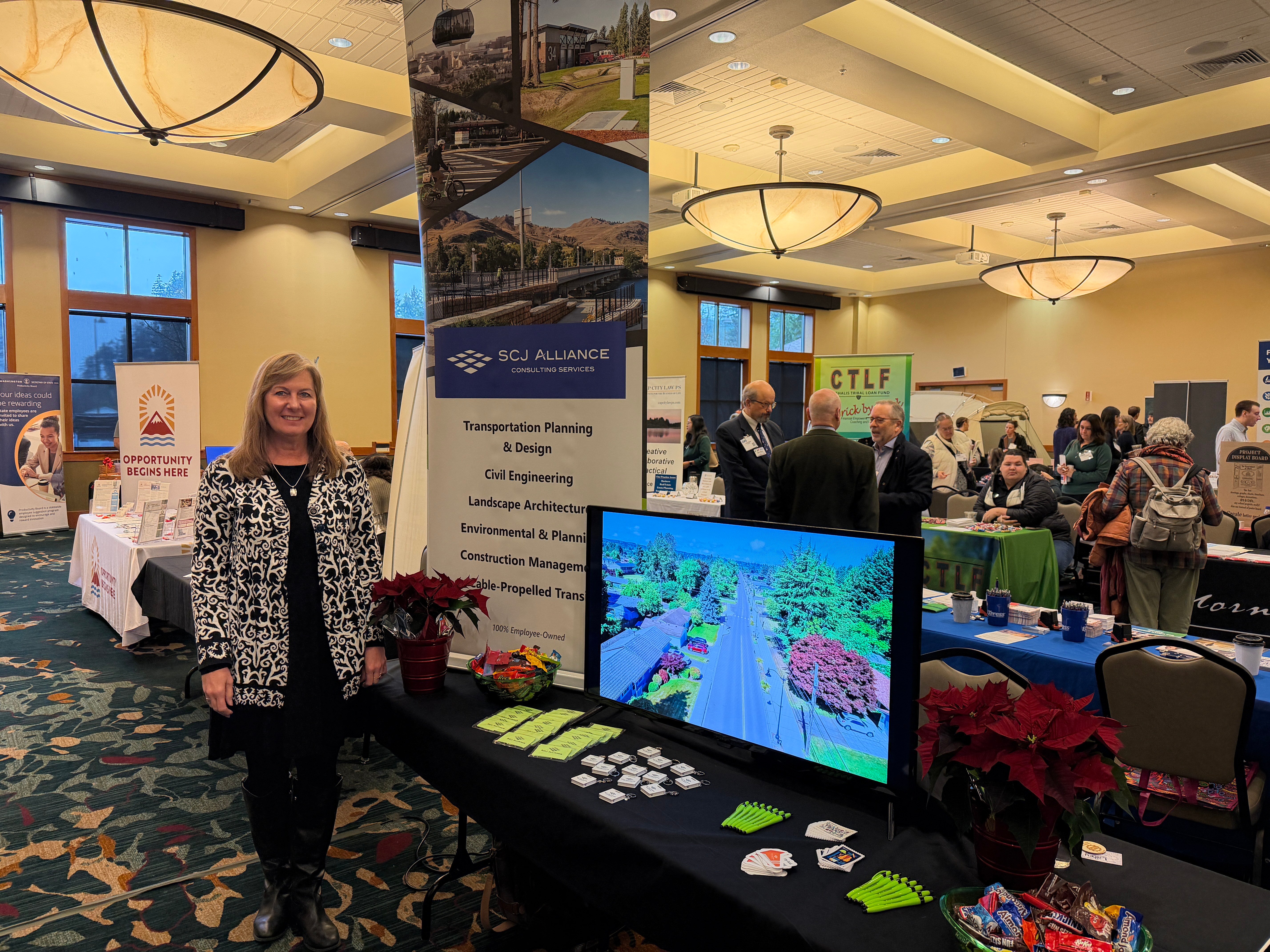
Pictured: Pam Folsom represented SCJ at a regional event called EDC (Economic Development Council) Expo.
A Culture Built on Connection
SCJ Alliance may specialize in projects such as civil engineering, transportation design, environmental and urban planning, and landscape architecture, but its heart lies in employee engagement and community involvement. The firm even has a mascot named Owl Pacino, the winning entry from a contest, that each office gets to play hide-and-seek with. An annual Roots and Recipes Potluck bring in family ancestry stories—and great food—and a gardening contest and virtual fishing derby attract unique family photos.
“It's always been really important for us to do cross-office collaboration and projects,” Folsom said. “We cannot have either the business groups or the offices be siloed, so it’s about keeping those connections. We also post stories on our intranet that highlight projects that maybe other groups or offices wouldn't know are happening. A homepage banner carousel switches pictures every week so that different people and groups are highlighted.”
Leadership That Champions Engagement
Folsom said that these activities have been encouraged from the start of the almost 20-year-old firm by the founders. “They were very involved in the community and believed in relational aspects, to do well both for your clients and each other. There's always been a tone of compassion and support here.”
Though many of those founders have retired, one remains, and she is Jean Carr, SCJ’s president and CEO.
“Jean’s a planner by profession, but her early hats included HR, IT, and marketing. When you have just seven people, you wear a lot of hats,” said Folsom. “As we've gotten bigger, she’s continued to emphasize connections and collaboration. A lot of energy and ideas come out of our HR and marketing departments, so it’s a collective effort.”
Recognition Programs That Build Relationships
That sharing philosophy carries over to other areas as well. Staff meetings feature peer-to-peer nominations where people regularly do work-related shoutouts of colleagues. Non-work shoutouts happen as well, such as for someone receiving a sportsmanship award for coaching a youth team or someone completing his or her first marathon.
“These are things that keep people connected and relatable to each other,” said Folsom. The firm also uses Nectar, a peer-to-peer employee recognition software, as another way to connect. Employees get points every month that they can then give to colleagues as gifts or prizes. Managers get a higher number that they can deliver specifically to team members.
Folsom believes that when it comes to employee engagement, it’s okay if just a few people respond to each initiative.
Finding What Resonates
“Some people will participate in the fishing derby, somebody else will do the recipe thing,” she said. “We've learned not to drop something just because only a fifth of the company did it. Different things hit different people, and even if someone doesn't participate, most of what we do highlights other people in the company or their interests, so it keeps us connected, which makes for better project outcomes. The more that you understand your colleague at an interpersonal level, the better the interactions, collaboration, problem-solving, and communication. You become happier at work, which makes you better at delivering to the client.
Five Tips for Employee Engagement
1. Use metrics to track your initiatives. SCJ uses Bamboo as its HR platform. It has satisfaction and engagement surveys that go out every other month or quarterly, depending on the topic, which are easily trackable.
2. Consider feedback training. SCJ conducted company-wide training specifically on giving and receiving feedback, Folsom said. “We felt like it was important enough for people not to walk around on eggshells or be afraid to say something to somebody because they were unsure of the reaction. And likewise, if something that I'm doing isn't working for someone, I want to hear it. But for that to happen, I need to have an appropriate response when someone gives me constructive feedback. Communication back and forth also helps keep people engaged.
3. Attend community events. Earlier this month, Folsom and about 10 colleagues represented SCJ at a regional event called EDC (Economic Development Council) Expo, where about 250 people from a five-county region attended. “It pulls in the movers and shakers in the public, private, and tribal worlds here,” Folsom said. “People attend workshops and hear speakers talk about the vitality of the economy and current issues. Washington has 29 federally recognized tribes. We've done a tribal health center, an RV park, and last year, corridor improvements alongside the Stillaguamish Tribe that won a national award.
4. Help clients identify grant opportunities. “We're really cued into the different ways that clients can leverage the dollars they have, and planning in particular,” Folsom said. “Community planning and development is one of our business groups.”
5. Evolve over time with what works. “Even though we are primarily office-based, like many firms we have a lot of flexibility with where people can work from,” Folsom said. “And the outcomes we create are the important part. But it's definitely easier to build relationships in person than virtually, and so I'm very thankful that we get to spend time together again.”
This is content from the PSMJ Newsletter, exclusive to PSMJ PRO Members. PSMJ PRO is the fastest-growing network of AEC firm leaders. Not a PRO Member? Try a 50-day trial (no credit card required). You can request a trial here: https://www.psmj.com/50daylite